
On this page
- Historic Roswell at a glance
- What makes Historic Roswell different?
- Do the historic district rules affect gutters?
- Gutter questions from Historic Roswell homeowners
- What gutter setup works best in Historic Roswell?
- How does the weather affect gutters in Historic Roswell?
- How much gutter does a Historic Roswell house usually need?
- What gutter work comes up most in Historic Roswell?
- Streets, water and landmarks in and around Historic Roswell
- Before you call about a Historic Roswell house
- Nearby areas
Historic Roswell at a glance
| Item | Detail |
|---|---|
| Where | Central Roswell, around the town square and above Vickery Creek |
| National Register | Roswell Historic District, listed May 2, 1974, about 120 acres |
| Local district | Established by the city in 1971 |
| Styles | Greek Revival and Late Georgian, from as early as 1837 |
| Landmarks | Bulloch Hall, Barrington Hall, the Old Bricks, the mill ruins |
| Rules | Certificate of Appropriateness for material changes in appearance |
What makes Historic Roswell different?
Roswell began with a cotton mill. Roswell King scouted the area in 1830 and returned in the mid-1830s to build the Roswell Mill on Vickery Creek, according to Wikipedia; its ruins and 30-foot dam remain after Union forces burned the mill during the Civil War. The town that grew around it is now the Roswell Historic District, listed on the National Register on May 2, 1974. It covers about 120 acres, with 28 contributing buildings and three contributing structures in Greek Revival and Late Georgian styles, some from as early as 1837. They include Bulloch Hall, completed around 1840 and the childhood home of Mittie Bulloch, mother of Theodore Roosevelt, and Barrington Hall, built in 1839. The Old Bricks were built to house mill workers.
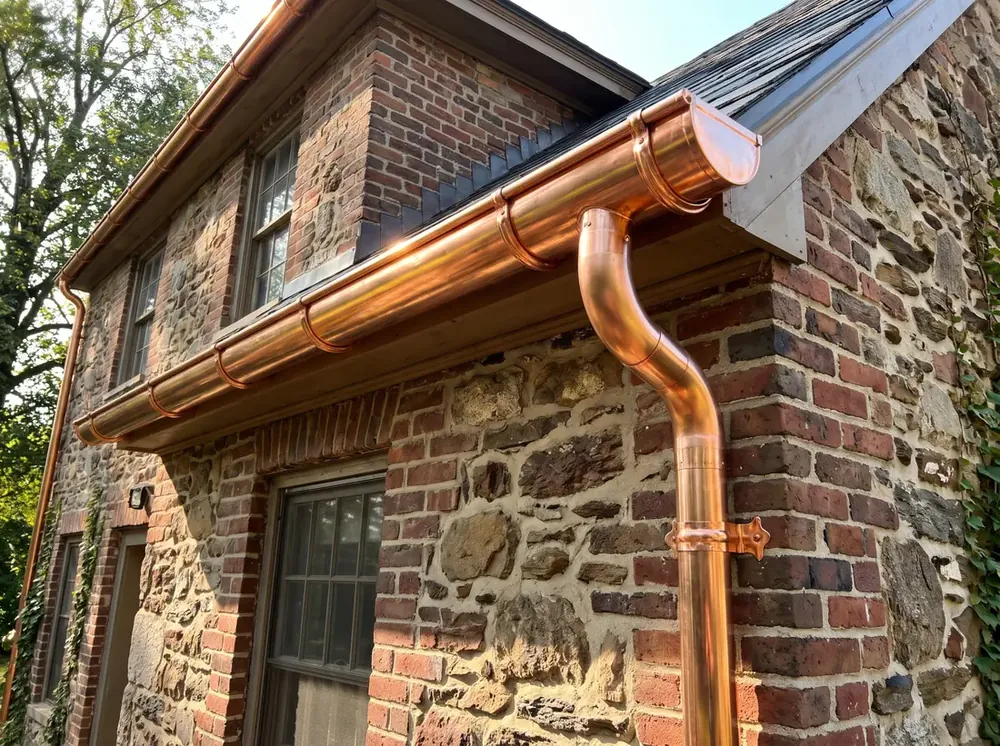
Houses like these have had many sets of gutters over the years, and the roof edges show it: spike holes, patched fascia, missing drip edge and, on some, no fascia at all. Half-round gutters in copper or dark aluminum often suit them better than modern K-style, and they need sizing up to cope with today's rain.
Do the historic district rules affect gutters?
They can. The city created its local historic district in 1971, according to its historic district master plan, and its ordinance requires a Certificate of Appropriateness from the Historic Preservation Commission before a material change in the appearance of a historic property, as a Georgia Attorney General opinion explains. Changing gutter style, material or color on a street-facing elevation is worth raising with city planning staff first. See gutters for historic Roswell homes.
Gutter questions from Historic Roswell homeowners
Should an old house here have half-round gutters?
Often, but ask what was there before and what the city expects. Half-round carries less than K-style of the same width, so it is usually sized up to 6-inch with enough downspouts.
Why does the wood behind my gutters keep rotting?
Usually water getting behind the gutter through missing drip edge, failed joints or overflow. Fix the water source as well as the boards.
How do I handle downspouts on a tight, older lot?
Run them toward the street or rear of the lot rather than a shared side yard, using extensions or buried lines where possible.
What gutter setup works best in Historic Roswell?
Most work in Historic Roswell is repair or like-for-like replacement on older buildings, rebuilt around sound wood and a better drainage layout.
| Part | Usual choice in Historic Roswell |
|---|---|
| Gutter | 6-inch half-round on many older houses; K-style on later homes |
| Metal | Copper or dark aluminum; .032 aluminum on newer homes |
| Downspouts | Round with half-round; 3x4 with K-style |
| Fastening | Brackets or strap hangers on older roof edges; hidden hangers elsewhere |
| Guards | Half-round or micro-mesh guards under big trees |
| Cleaning | Twice a year, more under oaks |
| Discharge | Extensions or buried lines toward the street or rear |
| Main risks | Old fascia, missing drip edge, undersized half-round |
| Rules | Certificate of Appropriateness for material changes in appearance |
How does the weather affect gutters in Historic Roswell?
Historic Roswell shares the city's climate: about 52.3 inches of precipitation a year in the Wikipedia climate table, with March wettest at about 6 inches. Mature trees along the old streets add leaves and limbs to every storm.
| Season | What it means for gutters in Historic Roswell |
|---|---|
| March to May | The wettest stretch, with pollen and catkins: oak catkins and pollen mat in older gutters |
| June to August | Thunderstorms and falling limbs: downpours find every weak joint on an old system |
| September to November | Tropical remnants, then the leaf drop: leaves from mature street trees fill troughs |
| December to February | Winter rain and the odd ice storm: winter rain soaks fascia already softened by leaks |
How much gutter does a Historic Roswell house usually need?
Gutters are priced per foot, so the length of the eaves drives most of the cost. The rows below multiply typical lengths by national installed ranges from Angi. They show scale, not quotes.
| House | Typical eave length | Gutter | National range installed |
|---|---|---|---|
| Small cottage | 100 to 140 ft | 5-inch seamless aluminum | about $900 to $1,820 |
| Two-story older house | 150 to 200 ft | 6-inch seamless aluminum | about $1,800 to $3,600 |
| Large historic home | 200 to 280 ft | 6-inch seamless aluminum | about $2,400 to $5,040 |
Tear-off, fascia carpentry, extra downspouts, buried lines, guards and tall walls all add to these figures.
What gutter work comes up most in Historic Roswell?
| House | Common problem | Usual fix |
|---|---|---|
| Antebellum or Victorian house | Undersized or failing half-round | Larger half-round in copper or aluminum |
| Mill-era cottage | Spikes and soft fascia | New fascia and bracket or hidden hangers |
| Commercial building near the square | Overflow above an entrance | Extra outlets and rerouted downspouts |
| House inside the district | Style change planned | Ask the city before ordering |
Streets, water and landmarks in and around Historic Roswell
- Roswell Mill: built on Vickery Creek in the 1830s; ruins and dam remain
- Bulloch Hall: Greek Revival, completed about 1840, now a city museum
- Barrington Hall: built in 1839
- The Old Bricks: built to house mill workers
Before you call about a Historic Roswell house
- Check whether the house is inside the historic district.
- Note the gutter style and metal now on the house.
- Look for soft or patched fascia.
- Note where downspouts drain and whether water reaches neighbors.
How to check a gutter contractor in Georgia
Georgia licenses residential and general contractors through the State Licensing Board for Residential and General Contractors, part of the Secretary of State's office. Licensing guides summarizing the law put the threshold at residential work valued over $2,500, so a full gutter replacement usually falls under it while a small repair may not. Ask for the license number and check it with the Secretary of State before you sign. A city business license is not the same thing. Get the quote in writing, naming gutter size, metal and thickness, color, hanger type and spacing, the number and size of downspouts, where each will drain and who removes the old gutters. Inside Roswell's historic district, a material change to a building's appearance needs a Certificate of Appropriateness from the city's Historic Preservation Commission, so check before visible details change.
Nearby areas
Riverside Roswell · Crabapple · Mountain Park · Sandy Springs