
On this page
- How do these guards compare?
- Where do screens and hoods make sense?
- What about heavy rain?
- What about the humid climate?
- Upkeep for each type
- A note on do-it-yourself guards
- Which guard for which tree?
- Terms you will hear
- Questions to ask
- Screens and hoods at a glance
- Where screens and hoods matters around Roswell
- A first step worth taking
How do these guards compare?
| Guard type | How it works | Strengths | Weaknesses here |
|---|---|---|---|
| Perforated screen | Metal or plastic sheet with holes | Inexpensive; stops broad leaves | Pine straw and catkins pass through |
| Reverse-curve hood | Solid cover; water follows the curve | Sheds large leaves well | Can overshoot in downpours; visible from the street |
| Foam insert | Foam block fills the gutter | Cheap and quick | Holds water, debris and seedlings |
| Brush insert | Bristles fill the gutter | Easy to remove | Catches debris that must be pulled out |
| Micro-mesh | Fine mesh on a frame | Stops most debris | Higher cost |
Where do screens and hoods make sense?
- Screens: houses with mostly broadleaf trees and few pines, on a budget.
- Reverse-curve: low-pitch roofs with large leaves, where the look suits the house.
- Foam or brush: short runs, sheds, or as a stopgap.
Under pines, oaks with a heavy catkin drop, or sweetgums, micro-mesh tends to outperform all of them. See micro-mesh guards.
What about heavy rain?
Roswell averages about 52.3 inches of precipitation a year, according to Wikipedia, with March the wettest month. Reverse-curve hoods depend on water clinging to the curve; in a cloudburst off a steep roof, some sheets straight over. Screens and inserts can be overwhelmed when leaves lie on them. Whatever the guard, ask how it handles valleys and inside corners.
What about the humid climate?
Foam and brush inserts stay wet longer in humid weather, so debris caught in them breaks down in place and can grow seedlings. Screens and hoods dry faster. All guards benefit from a check after the spring catkin drop and the fall leaf drop.
Upkeep for each type
- Screens: brush leaves off the top; look underneath once a year for needles.
- Reverse-curve hoods: clear the slot if debris rides in.
- Foam and brush: pull out and clean, or replace, every year or two.
A note on do-it-yourself guards
Screens and foam inserts sold in home stores are easy to fit on a single-story house. The common mistakes are fitting them over gutters that are already loose or badly sloped, pushing them under shingles in a way that lifts the roof edge, and forgetting them until the trough beneath fills with fine debris. If you fit them yourself, check underneath once a year.
Which guard for which tree?
Broad leaves from maples, oaks and tulip poplars are stopped by almost any guard. Pine straw and fine catkins pass through screens and can ride into hood slots, which is where micro-mesh earns its price.
Terms you will hear
| Term | What it means on a Roswell house |
|---|---|
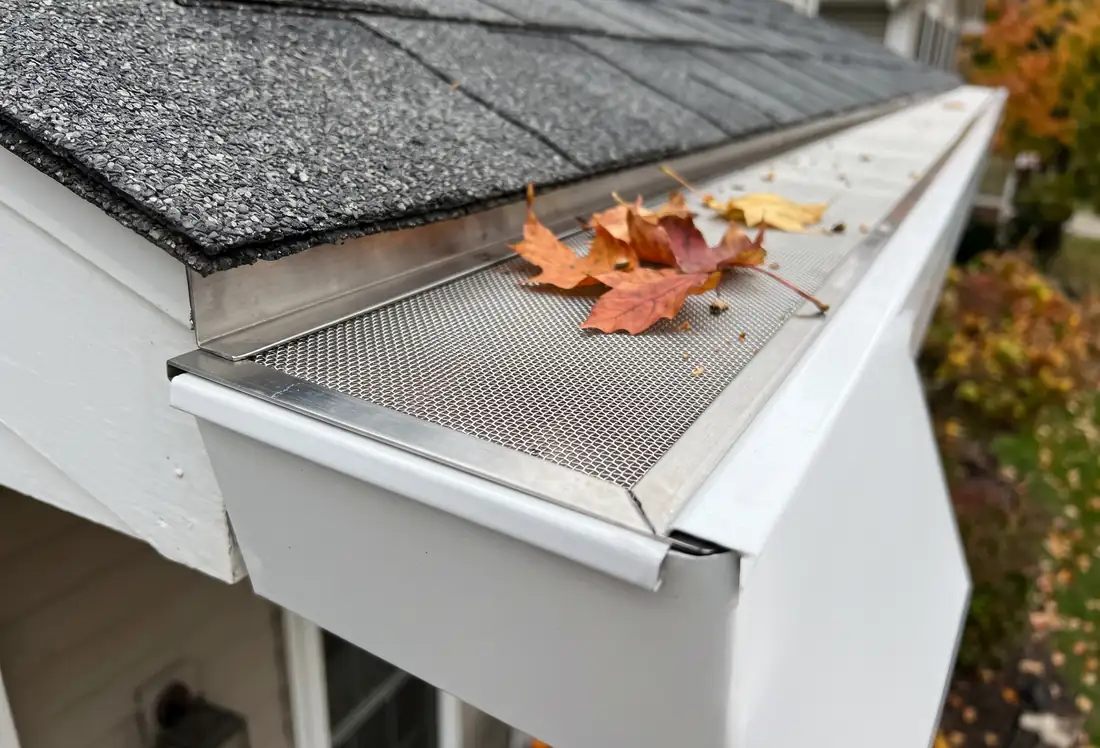
| Screen guard | A perforated panel with bigger holes. It stops leaves and sweetgum balls but lets needles and seeds pass. |
| Reverse-curve guard | A solid hood that sends water around its curved nose into the gutter while leaves slide off. In a very heavy downpour water can overshoot it. |
| Foam insert | A porous block that sits in the trough. Inexpensive, but fine debris collects in it and seedlings take root. |
| Micro-mesh guard | A fine stainless mesh on a frame over the gutter that stops pine needles, oak catkins and grit while letting rain through. |
| Valley diverter | A small metal fin in the gutter below a roof valley that keeps a rush of water from shooting over the front. |
Questions to ask
- Which trees are over the house, and which guard suits them?
- How does the guard attach, and does it disturb the shingles?
- How does it handle valleys and steep sections?
- How is it cleaned when needed?
See are gutter guards worth it.
Screens and hoods at a glance
| What people ask | Short answer |
|---|---|
| Pine needles? | Screens let them through |
| Heavy rain? | Hoods can overshoot |
| Foam inserts? | Hold water and debris |
| Best under pines? | Micro-mesh |
Where screens and hoods matters around Roswell
| Neighborhood or town | Why it comes up there |
|---|---|
| Crabapple | Open lots with light debris |
| Milton | Barns and outbuildings where cost matters |
| East Cobb | Broadleaf trees over older ranches |
A first step worth taking
Before buying any guard, note what falls on your roof through a whole year. A guard that suits fall leaves may not suit spring catkins.
How to check a gutter contractor in Georgia
Georgia licenses residential and general contractors through the State Licensing Board for Residential and General Contractors, part of the Secretary of State's office. Licensing guides summarizing the law put the threshold at residential work valued over $2,500, so a full gutter replacement usually falls under it while a small repair may not. Ask for the license number and check it with the Secretary of State before you sign. A city business license is not the same thing. Get the quote in writing, naming gutter size, metal and thickness, color, hanger type and spacing, the number and size of downspouts, where each will drain and who removes the old gutters. Inside Roswell's historic district, a material change to a building's appearance needs a Certificate of Appropriateness from the city's Historic Preservation Commission, so check before visible details change.