
On this page
- The short answer
- Why rain intensity matters more than the yearly total
- Side by side
- How roof area and rain combine
- What else affects the choice?
- Alternatives to upsizing
- Looks and proportion
- Terms you will hear
- Gutter size at a glance
- Where gutter size matters around Roswell
- A first step worth taking
- Mixing sizes on one house
- Questions to ask a contractor
- Checking after the change
The short answer
| Choose 5-inch when | Choose 6-inch when |
|---|---|
| The house is a ranch with a simple roof | The house is two-story or the roof is large |
| Roof pitch is low to moderate | The roof is steep |
| There are few valleys | Valleys pour into inside corners |
| Runs are short with outlets at each end | Runs are long with one outlet |
| Clean 5-inch gutters do not overflow | Clean 5-inch gutters overflow in downpours |
Why rain intensity matters more than the yearly total
Roswell averages about 52.3 inches of precipitation a year in the Wikipedia climate table. That number tells you how much rain falls, not how fast. Gutters are sized for the heaviest bursts: spring storms and summer thunderstorms. In the September 2009 floods, the National Weather Service recorded a maximum 24-hour total of 21.03 inches in Douglas County, west of Atlanta. No residential gutter is built for that, but the lesson is that storms here can be far heavier than the averages suggest.
Side by side
| Feature | 5-inch K-style | 6-inch K-style |
|---|---|---|
| Relative capacity | Standard | About 40% more |
| Usual downspout | 2x3 or 3x4 | 3x4 |
| Stiffness | Lower | Higher |
| Weight when full | Lower | Higher; closer hangers |
| Looks | Neater on small houses | In proportion on larger houses |
| National price per foot installed, aluminum | About $9 to $13 | About $12 to $18 |
Prices from Angi.
How roof area and rain combine
One inch of rain on 1,000 square feet of roof is about 620 gallons. A 2,400-square-foot roof sheds about 1,500 gallons per inch, and a summer storm can deliver an inch in under an hour. Splitting that between more outlets, or carrying it in a bigger gutter, is the whole game. Contractors usually work out each run's share of the roof and size it on its own.
What else affects the choice?
- Roof area per outlet. More outlets means each carries less; a second downspout can do as much as upsizing.
- Pitch. Steep roofs send water faster and can overshoot a small gutter.
- Valleys. Two slopes meeting at an inside corner concentrate water; a valley diverter helps.
- Trees. Bigger gutters and downspouts pass debris more easily, but guards still help under oaks and pines.
- Upper roofs. Water from an upper roof landing on a lower one adds to the lower gutter's load.
Alternatives to upsizing
- Add an outlet and downspout in the middle of a long run.
- Change 2x3 downspouts to 3x4.
- Add valley diverters at inside corners.
- Reset the slope so water does not stand.
- Keep gutters clean, or fit micro-mesh guards.
Looks and proportion
Size changes how the house looks. A 6-inch gutter has a taller face, which suits two-story houses, wide fascia and large roofs. On a small ranch with narrow fascia, 5-inch often looks neater. Matching the gutter color to the trim reduces the difference either way.
Terms you will hear
| Term | What it means on a Roswell house |
|---|---|
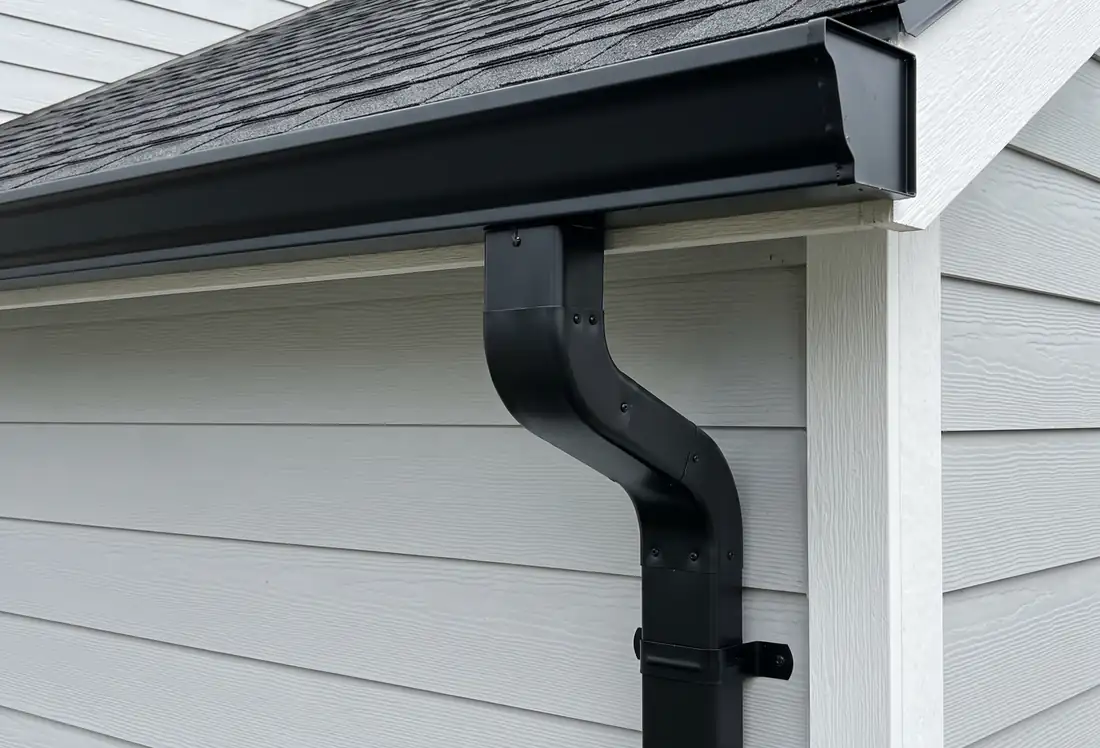
| K-style gutter | The usual flat-backed profile with a curved face. Width for width it carries more water than half-round. |
| Downspout | The upright pipe that brings water down from the gutter. Common sizes are 2x3 and 3x4 inches. |
| Outlet | The hole in the gutter bottom where the downspout connects, usually through a riveted drop sleeve. |
| Valley diverter | A small metal fin in the gutter below a roof valley that keeps a rush of water from shooting over the front. |
| Slope | The gentle fall of a gutter toward its outlet, commonly about a quarter inch in 10 feet, so water does not sit in the trough. |
| Gauge | Metal thickness. Residential aluminum gutter is usually .027 or .032 inch; the heavier coil resists dents from limbs and ladders. |
See 6-inch gutters and overflowing gutters.
Gutter size at a glance
| What people ask | Short answer |
|---|---|
| Default for ranches? | 5-inch |
| Default for two-story? | Often 6-inch |
| Downspout with 6-inch? | 3x4 |
| Cheaper alternative? | More outlets or diverters |
Where gutter size matters around Roswell
| Neighborhood or town | Why it comes up there |
|---|---|
| Johns Creek | Two-story homes with valleys |
| Crabapple | Large newer roofs |
| Norcross | Smaller cottages where 5-inch fits the look |
A first step worth taking
Watch the gutters in the next downpour. If clean gutters spill along the whole run, size is the issue; if they spill at one corner, start with a diverter.
Mixing sizes on one house
There is no rule that every run must match. A common pattern is 6-inch on the upper rear run, which drains the largest roof plane, and on any run under a valley, with 5-inch on simpler front and side runs. Matched color and profile keep the look consistent from the street.
Questions to ask a contractor
- Which runs need 6-inch, and why?
- How many outlets on each run?
- 3x4 downspouts throughout?
- Any valleys that need diverters?
Checking after the change
After any change, watch the gutters in the next heavy rain. Water should stay in the trough and run steadily from every downspout.
How to check a gutter contractor in Georgia
Georgia licenses residential and general contractors through the State Licensing Board for Residential and General Contractors, part of the Secretary of State's office. Licensing guides summarizing the law put the threshold at residential work valued over $2,500, so a full gutter replacement usually falls under it while a small repair may not. Ask for the license number and check it with the Secretary of State before you sign. A city business license is not the same thing. Get the quote in writing, naming gutter size, metal and thickness, color, hanger type and spacing, the number and size of downspouts, where each will drain and who removes the old gutters. Inside Roswell's historic district, a material change to a building's appearance needs a Certificate of Appropriateness from the city's Historic Preservation Commission, so check before visible details change.